Do I Really Need Brake Repair? A Mechanic Explains What to Watch For
A Note from The Worthington Automotive Team Before We Start
If you’re here because your car made a noise that caught your attention, or because a shop gave you a brake recommendation and you’re not completely sure whether to trust it, you’re exactly who this article is written for.
Table of Contents
ToggleWe hear these concerns every single week at 999 Worthington Woods Loop Rd. Families who aren’t sure what they’re hearing. People who’ve been quoted numbers that feel high for Automotive Repair Services and given explanations that came too fast. Drivers who just want someone to be straight with them about what’s actually going on and what it’s going to cost.
That’s what this is. Honest answers from an ASE-certified mechanic shop that would rather explain your brakes clearly than pressure you into anything.
Read what applies to your situation. And when you’re ready, call 614-468-1666. We’re always glad to talk through a concern before you even come in.
Why Brake Noises Feel So Alarming (Even When They’re Not)
Brakes are one of the few car systems that announce a problem out loud. You’re driving to school pickup or running Saturday errands in Worthington, everything feels completely normal, and then your car makes a sound that immediately gets your attention. A squeak. A grind. A scrape on the first stop of the morning. And in that moment, the mental math starts.
Here’s the thing, though: the anxiety doesn’t usually come from the sound itself. It comes from uncertainty. Not knowing what the noise means, whether it’s serious, whether someone is about to quote you a number that wipes out a weekend’s worth of plans. Most drivers aren’t mechanics, and they shouldn’t have to be. But without a clear framework, every brake sound carries the same weight, whether it’s a completely normal morning squeak or something that genuinely needs attention this week.
This article gives you that framework. Work through it, apply it to what you’re hearing, and feel free to call us afterward. Free brake inspection, no commitment, no pressure.
What Does a Squeaking Brake Actually Mean?
Squeaking or squealing is the most common brake concern we hear at our shop in Worthington, and the answer varies depending on what kind of squeak it is and when it happens.
Morning squeak that clears up: usually nothing to worry about
If your brakes squeal for the first stop or two and then go completely quiet, that’s almost always surface rust. Overnight moisture, Ohio dew, and morning humidity all cause a thin rust layer to form on the rotor surface. When you brake, the pad scrapes it off, and that contact creates the noise. It clears within a minute or two of driving.
This is especially common in Central Ohio from spring through fall. If the squeal is exclusively in the morning and reliably gone by the time you’re out of your neighborhood, it’s usually not a concern. That said, if it’s been taking longer to clear or happening at other times too, mention it when you’re in for something else.
Consistent squealing every time you brake: your car is sending a signal
Many brake pads have a small metal wear indicator built into the pad material. Its entire job is to make a squealing sound when the pad wears down to a certain level. That consistent squeal every time you apply the brakes is that indicator doing exactly what it was designed to do.
It’s not a crisis. It’s a heads up. You likely have some time, but this is a schedule-an-inspection-this-week situation, not a file-it-away-for-a-few-months situation. Pad life at the wear indicator stage can run out faster than you’d expect, particularly in the stop-and-go driving that’s common around Worthington and Columbus.
High-pitched screech with pedal vibration: get this checked soon
When squealing is accompanied by a pulsing or vibrating sensation in the pedal or steering wheel, that typically points to warped rotors. Rotors can warp from heat cycles, repeated hard stops, or age. The metal surface becomes slightly uneven, and you feel the pad skipping across the irregularities as you stop. This combination of sound and sensation warrants a more prompt inspection than squealing alone.
Squealing after new brake pads: usually temporary
If you’ve recently had new pads installed and they’re making noise, don’t worry right away. New pads sometimes squeal during the bedding-in period while the pad and rotor surfaces are breaking in against each other. This typically resolves within a few hundred miles of normal driving. If it persists longer than that, give us a call.
What Does a Grinding Brake Mean and Why Does It Matter?
Grinding moves the conversation from schedule soon to schedule this week. Here’s why.
When brake pads wear down completely, the metal backing plate of the pad starts contacting the rotor directly. That’s the grinding sound. Metal on metal. The pad is gone. The wear indicator has already done its job, the signal wasn’t acted on, and now the rotor itself is being damaged with every stop.
Why does this matter beyond the obvious safety concern? Because cost compounds quickly. What would have been a straightforward pad replacement can become a pad-and-rotor job because the rotor has been scored and can no longer be safely used. The difference in repair cost between those two scenarios is real and grows with every mile driven on grinding brakes.
Beyond cost, braking distance increases when pads are gone. Emergencies, wet roads, unexpected stops, those moments where you need every bit of your car’s braking capacity, those are affected. This is the safety dimension we want families to understand clearly.
If you’re grinding, please don’t wait beyond this week. You don’t need to pull over unless the car genuinely isn’t stopping properly, but this needs attention soon. 614-468-1666 or worthingtonautomotive.com/schedule-service.
What Other Brake Symptoms Should Families Watch For?
Not every brake problem announces itself with noise. Several symptoms get dismissed or attributed to something else, and they’re worth knowing.
Brake pedal that feels soft, spongy, or lower than normal
If the pedal feels mushier than it used to, or if it travels further before the car responds the way you expect, something has changed in the hydraulic side of your brake system. This can point to air in the brake lines, low brake fluid, a slow leak, or a master cylinder issue. Any of these warrants a prompt inspection because this category of symptom can change unexpectedly and quickly.
Car pulling to one side when you brake
If your car drifts noticeably left or right during braking, that suggests uneven performance between the two sides of an axle. Common causes include a sticking caliper, uneven pad wear, or brake components at significantly different wear stages. This affects how your vehicle handles in a braking situation, and it’s something to have looked at.
Brake warning light on the dashboard
The brake warning light can indicate low brake fluid, an ABS issue, or a parking brake concern. Not every trigger is equally urgent, but none should be ignored. A free inspection or free code scan at Worthington Automotive identifies exactly what the light is responding to. Call us and tell us what’s on. We can often help you understand the likely cause before you even come in.
Vibration through the steering wheel when braking from highway speed
Feeling a shudder through the steering wheel when you slow down from 55 or 65 is a classic sign of warped front rotors. The surface has become uneven from heat cycling, and you feel the pad contacting the highs and lows as you brake. It tends to worsen over time, and it affects braking quality even when it feels like just an annoyance.
Burning smell after driving or after heavy braking
A sharp smell after stop-and-go traffic, a long downhill, or towing can indicate overheated brakes or a caliper that’s holding the pad in constant light contact with the rotor. If this happens once after unusual conditions, it may not be a concern. If it keeps happening, it’s worth an inspection.
When Are Brakes Urgent and When Can They Wait?
The most common question we get, and it deserves a direct answer. Here’s a practical guide rather than a vague “it depends.”
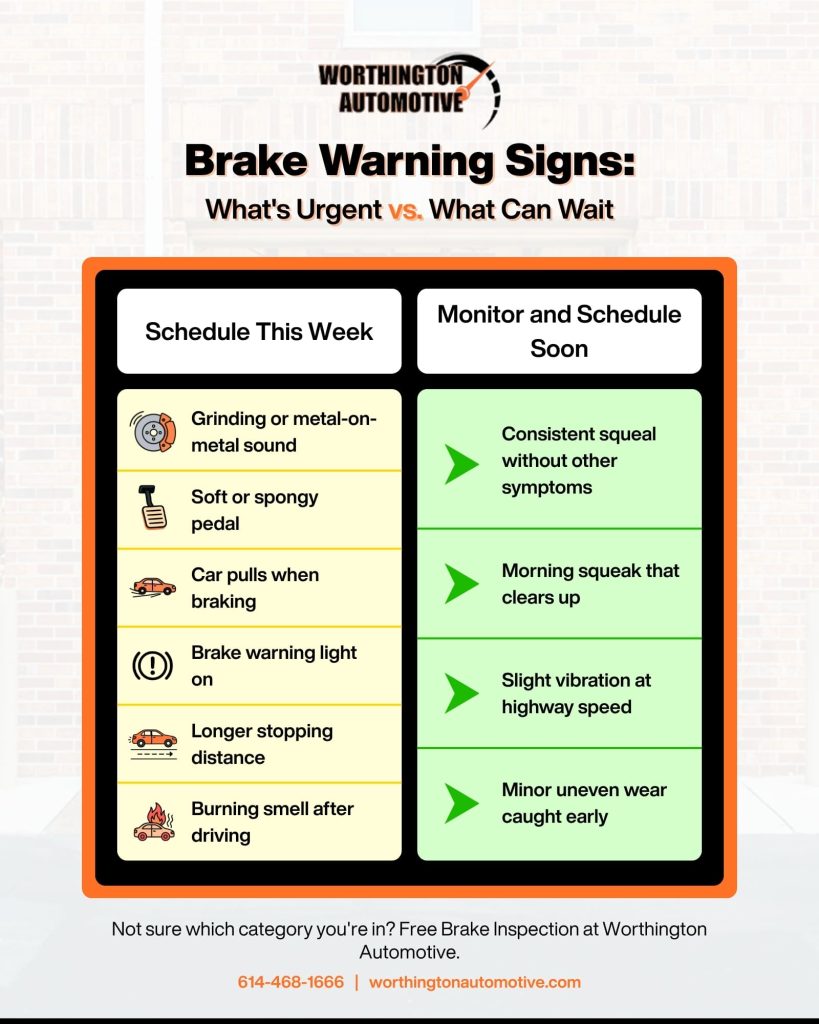
Get this looked at this week
- Grinding or a metal-on-metal sound during braking
- Soft, spongy, or lower-than-normal brake pedal
- Car pulling significantly to one side during braking
- Brake warning light illuminated
- Pedal pulsing or vibrating during normal braking
- Noticeably longer stopping distance than usual
- Burning smell after driving that keeps recurring
- Squealing combined with any of the symptoms above
Schedule an inspection in the next week or two
- Consistent squealing on every stop without other symptoms
- Wear indicator squeal that started recently
- Slight vibration at highway speeds without other urgency symptoms
- Minor uneven wear caught during a routine inspection
Note at your next service visit
- Morning squeak that reliably clears within the first few stops
- Very occasional light squeal that doesn’t repeat consistently
The honest caveat: even the monitor category benefits from an actual inspection because pad thickness measurements tell a more reliable story than symptoms alone. We offer free brake inspections so families can get a real answer instead of guessing. 614-468-1666.
How Long Can You Drive with Worn or Bad Brakes?
One of the most searched brake questions, and it deserves a straight answer, not a hedge.
If your brakes are squealing from a wear indicator but otherwise feel and function normally, you likely have a short window. Not months. A week or two of typical Central Ohio driving is a reasonable frame. This isn’t permission to keep going indefinitely. It’s a realistic acknowledgment that you can schedule without panic, but you shouldn’t keep delaying.
If you’re hearing grinding, the calculus changes. Every day of driving on grinding brakes means more rotor damage and more cost. It also means reduced braking effectiveness in ways that feel almost normal until they’re not. We’d say don’t wait beyond this week.
If your pedal feels soft or the car is pulling during braking, these are system-level symptoms that can change more unpredictably than worn pads. Get those checked before your next significant drive.
The version of this answer we’d give to a family member: if something feels off with your brakes, find out what it is. The peace of mind from knowing is worth more than the convenience of waiting one more week. And the inspection is free.
What Do Brakes Actually Cost to Repair in Central Ohio?
Pricing transparency is one of the things families tell us matters most when they’re choosing a mechanic. We agree. Here’s a clear picture.
Brake pad replacement per axle on most cars: $150 to $300
This is the most common brake service. If pads are worn but the rotors are still in good shape, replacing pads alone is typically the most cost-effective path. On most everyday family vehicles we service in Central Ohio, this runs $150 to $300 per axle. Front brakes typically wear faster than rear brakes because they handle more of the braking load.
Brake pads and rotors per axle on most cars: around $425 with our current offer
When rotors are worn past safe thickness, scored from grinding, or warped beyond tolerance, they need to be replaced along with the pads. We currently offer $425 pads and rotors per axle on most cars. That’s a competitive price compared to most shops in the Worthington and Columbus area, and we’re upfront about it before any work begins.
What if both the front and rear both need service?
Brakes don’t always wear evenly front to back. Sometimes only one axle needs work. We’ll inspect all four corners during a free brake inspection and tell you exactly what each axle looks like so you can prioritize if needed.
Brake fluid service
Brake fluid absorbs moisture over time, which lowers its boiling point and reduces braking performance in demanding situations. If it’s been several years or if the fluid looks dark and contaminated, a flush is worth considering. It’s typically a modest add-on to a brake service visit, not a standalone expensive procedure.
Financing available if needed
We offer financing through Koalafi at worthingtonautomotive.com/financing. Unexpected car repairs don’t always happen at convenient times. A clear estimate before anything starts and a financing option means families can make decisions that actually fit their situation.
See all current coupons and offers at worthingtonautomotive.com/coupons.
What to Expect from a Free Brake Inspection at Worthington Automotive
A free brake inspection takes about 20 minutes and gives you a complete, honest picture of where your brakes actually stand. Here’s exactly what we do.
Step 1: We remove the wheel and inspect it directly
Our ASE-certified technicians pull the wheel and visually inspect pad thickness using a measuring tool, the rotor surface for scoring, grooving, cracks, or heat damage, and the brake hardware for corrosion or wear. We also look at how evenly the pads have worn across the face of the rotor, which tells us about caliper function and driving patterns.
Step 2: We check the calipers
Sticking calipers are one of the most common causes of premature brake wear that families don’t know about until it’s caused significant damage. A caliper that isn’t fully releasing keeps the pad in partial contact with the rotor even when you’re not braking, generating heat, accelerating pad wear, and potentially damaging the rotor. We check that every caliper is moving freely.
Step 3: We check the brake fluid condition
We test the fluid for moisture content and check the reservoir level. Fluid that’s significantly degraded shows up clearly in testing. If it’s something worth addressing, we’ll tell you why it matters in practical terms, not just flag it to add to a bill.
Step 4: We look at the full system
While we’re in there, we also check brake lines for any signs of leakage, the ABS sensor if accessible, and overall brake hardware condition. If anything beyond pads and rotors warrants a mention, we bring it up with the inspection results.
Step 5: We explain what we found in plain language with no pressure
This is the part families consistently tell us feels different from what they’ve experienced elsewhere. We sit down and walk through the findings. What’s urgent, what can wait, what it would cost, and what your options are. We will show you the measurements. We answer every question without rushing toward a decision. You leave knowing exactly where your brakes stand and what makes sense next.
Schedule at worthingtonautomotive.com/schedule-service or call 614-468-1666. We’re at 999 Worthington Woods Loop Rd, and we serve Westerville, Dublin, Powell, Delaware, and all of Central Ohio.
Should You Get a Second Opinion on Brake Repair?
Yes. Absolutely. Any mechanic who makes you feel uncomfortable for wanting one is a mechanic worth being skeptical of.
A second opinion is an independent assessment from another qualified shop. If the original recommendation was legitimate, confirmation from us means you can proceed with complete confidence. If something was off, you find out before you spend the money.
We offer free second opinions at Worthington Automotive. You come in, tell us what you were quoted and what was recommended, share the written estimate if you have it, and we will inspect the relevant components. We then tell you exactly what we see. If the first shop was right, we say so. If the picture looks different, we walk you through why.
No charge. No judgment. No pressure to use our shop.
We hear from families regularly who came in for a second opinion and ended up becoming long-term customers. That’s not a tactic. It’s what happens when someone finally experiences an inspection conversation that doesn’t feel like a pitch. 614-468-1666.
Summer Driving and Your Brakes: What Central Ohio Families Should Know
Winter gets more attention for car maintenance in Ohio, and that makes sense. But summer puts its own demands on your brakes, and it’s worth understanding what those look like.
Road trips mean more miles and more varied terrain
If your family is heading to Put-in-Bay, Hocking Hills, Cedar Point, or anywhere involving meaningful highway time and roads you don’t drive every day, knowing where your brakes stand before you go is genuinely smart. Borderline brakes at home are brakes you’re counting on, far from a shop you trust. A free 20-minute inspection before a summer trip is one of the easiest safety checks you can do.
Heat and heavier loads affect brake performance
Ohio summers get legitimately hot, and heat contributes to brake fade, particularly in vehicles used for towing, carrying heavy loads, or navigating long descents. If your summer involves a boat trailer, a camper, or a fully loaded SUV heading to the lake, your brakes are working harder than usual, and it’s worth making sure they’re ready for it.
Kids are out of school and in the car more
Summer means more of your family in your vehicle more frequently. Sports camps, day trips, evening activities, weekends away. The family car is doing more and carrying more people than it does the rest of the year. It’s a genuinely good time to make sure it’s ready.
Getting a free check before the season gets fully underway
We offer free brake inspections because we think knowledge should be free. Twenty minutes at our shop, a clear picture of where your brakes stand, and you leave with peace of mind instead of uncertainty. 614-468-1666.
What Happens When You Keep Putting Off Brake Repair?
We share this not to alarm anyone but because we genuinely think families deserve to understand the progression. It’s information we’d give to someone in our own family.
The first stage is low pads with a working wear indicator. You’re hearing consistent squealing. The pads are getting low, but haven’t run out. A pad replacement per axle at this stage is a $150 to $300 repair. The rotors are fine. It’s a straightforward service.
The second stage is pads worn to the metal backing. The squealing has been going on for a while without action. Metal contacts the rotor. You hear grinding. The rotor starts accumulating scores with every stop. Pad and rotor replacement per axle is now the outcome, typically $300 to $500 and more, with our current offer applied. Still manageable. Still, something most families can work through.
The third stage is extended grinding. The rotor has been damaged for weeks. Deep grooves. In some cases heat damage or structural concerns. The repair becomes more involved, and the safety risk during this period is real. Braking distance is noticeably reduced, even if it doesn’t feel dramatic in everyday driving.
Earlier is almost always cheaper and safer. A free inspection costs nothing and tells you exactly where in this progression you are. 614-468-1666.
Common Brake Myths That End Up Costing Families More
A few things we hear at our shop that aren’t quite right, and what’s actually true.
“The brake warning light will tell me when my pads are worn.”
It won’t, at least not reliably. The brake warning light has specific triggers and worn brake pads often aren’t one of them. Many vehicles rely entirely on the physical wear indicator noise as the low-pad signal. The light is more commonly triggered by low brake fluid, ABS issues, or parking brake concerns. If you’re waiting for the dashboard light to tell you your pads need replacing, you may be well past the point where you should have acted.
“If my car stops fine, my brakes are fine.”
This one catches families off guard. Brakes can be significantly worn and still stop your car adequately in normal driving. The performance gap shows up in emergency stopping situations, hard braking, wet pavement, and the moments where you need maximum braking capacity. By the time brakes feel obviously different in normal driving, they’re often already well into the second or third stage of wear.
“Brake work is always really expensive.”
It isn’t, when it’s caught early. Pad replacement per axle runs $150 to $300 for most family vehicles. We offer $425 pads and rotors per axle right now. These are manageable numbers, especially compared to the cost of a repair that’s been delayed. Brake work gets expensive when it’s ignored. Caught early, it’s one of the more affordable safety services there is.
“I’ll definitely know when something is wrong.”
Sometimes yes. But worn brakes can feel almost completely normal until they’re genuinely far gone. The feedback your car gives you in everyday driving doesn’t always reflect where the brakes actually are. Annual inspections are more reliable than relying on feel alone.
“Every shop is just trying to upsell me.”
We completely understand why families feel this way. Some shops do push unnecessary services, and that experience sticks. The protection against it isn’t to distrust every recommendation. It’s to find a shop that shows you the measurements, explains what they see, and tells you clearly what can be done. That’s what we do. And if you’re not sure, get a second opinion from us. It’s free.
How Diagnostics Connect to Your Brake and Safety Systems
Brakes don’t operate in isolation. They’re part of a larger safety system that includes the ABS, stability control, and traction control in most modern vehicles. When something in this system triggers a warning light or behaves unexpectedly, a diagnostic scan is often the right first step.
The check engine light and the ABS warning light are different systems that sometimes appear together or in sequence when brake-related issues are present. A free code scan at Worthington Automotive reads the diagnostic trouble codes from your car’s computer and tells you what’s been flagged. We explain those codes in plain language, not technical shorthand.
If your check engine light came on around the same time you noticed something with your brakes, mention that when you call or come in. There’s sometimes a direct connection, and seeing the full picture at once saves time and avoids misdiagnosis.
Free code scans available at Worthington Automotive. 614-468-1666.
Why Families in Worthington, Westerville, Dublin, and Powell Trust Us
We’re not the biggest shop in Central Ohio, and we’re not trying to be. What we are is consistent, honest, and genuinely invested in the families we serve.
People choose Worthington Automotive because they want someone who explains things in plain language before asking them to spend money. They want a mechanic who separates urgent from optional and says which is which clearly. They want to feel respected, not rushed. And they want to know that when we say a repair can wait, we mean it.
That’s how we operate every single day. Our ASE-certified team does quality work at fair prices, and we back it with communication that treats every family like they deserve to understand what’s happening with their car.
We also offer free loaner vehicles for longer repairs because daily life in Central Ohio doesn’t pause for a shop visit. Kids need to get picked up. Work doesn’t stop. A loaner makes the whole experience more manageable.
999 Worthington Woods Loop Rd, Worthington, OH 43085 | 614-468-1666 | worthingtonautomotive.com
Serving Worthington, Westerville, Dublin, Powell, Delaware, Lewis Center, and Columbus, OH
Ready to Get Your Brakes Checked?
If something sounds different, feels different, or you just haven’t had your brakes looked at in a while, we’d genuinely be glad to take a look.
Free brake inspection. Free second opinion. Free code scan. Clear explanation of what we find. No pressure to commit to anything.
Call us at 614-468-1666 or schedule online at worthingtonautomotive.com/schedule-service.
Current offer: $425 pads and rotors per axle on most cars. All coupons at worthingtonautomotive.com/coupons.
Need to spread out a repair? Financing at worthingtonautomotive.com/financing.
Worthington Automotive. Honest answers. Fair prices. No pressure. That’s the whole thing.
Frequently Asked Questions (FAQs)
Do I really need brake repair if my car still stops fine?
Not necessarily, but “stops fine” in everyday driving can be misleading. Brakes that are significantly worn can still function adequately in normal traffic. The gap shows up in emergencies where you need maximum braking capacity. A free inspection at Worthington Automotive takes about 20 minutes and tells you exactly how much pad life remains and what the realistic timeline looks like. No commitment, no pressure. 614-468-1666.
What does a squeaking brake sound mean?
It depends on when it happens. Morning squealing that clears after a stop or two is usually normal surface rust from overnight moisture, very common in Ohio. Consistent squealing every time you brake is typically the wear indicator telling you pads are getting low. Squealing combined with pedal vibration can mean warped rotors. Each has a different level of urgency. The reliable way to know is a free brake inspection. Worthington Automotive, Worthington, OH, 614-468-1666.
How much does brake repair cost at Worthington Automotive in Worthington, OH?
Brake pad replacement per axle on most cars typically runs $150 to $300. Pads and rotors per axle on most cars run $300 to $500, and we currently offer $425 pads and rotors per axle on most cars. Every estimate is provided before work begins. Financing is available at worthingtonautomotive.com/financing. Current coupons at worthingtonautomotive.com/coupons.
Is it safe to drive with the brake warning light on?
It depends on what triggered it. The light can indicate low brake fluid, an ABS issue, or a parking brake concern, and you won’t know which one without a scan. None of them should be ignored. We offer free code scans at Worthington Automotive. Call 614-468-1666 before your next significant drive if the light is on.
How often should brake pads be replaced?
Brake pad lifespan varies a lot based on driving habits, vehicle weight, and pad type. The general range is 30,000 to 70,000 miles, but this varies significantly with driving conditions. Stop-and-go traffic, heavier vehicles, and hilly terrain all shorten pad life. Annual inspections are more reliable than relying on mileage alone. Free inspection at Worthington Automotive. 614-468-1666.
Can I get a free second opinion on brake work at Worthington Automotive?
Yes. Bring your vehicle in and tell us what you were quoted and what was recommended. We’ll inspect the brakes and give you our honest assessment. If the other shop is right, we’ll confirm it. If it looks different, we’ll explain exactly what we see. No charge, no pressure. 614-468-1666.